
On this page · 6 sections
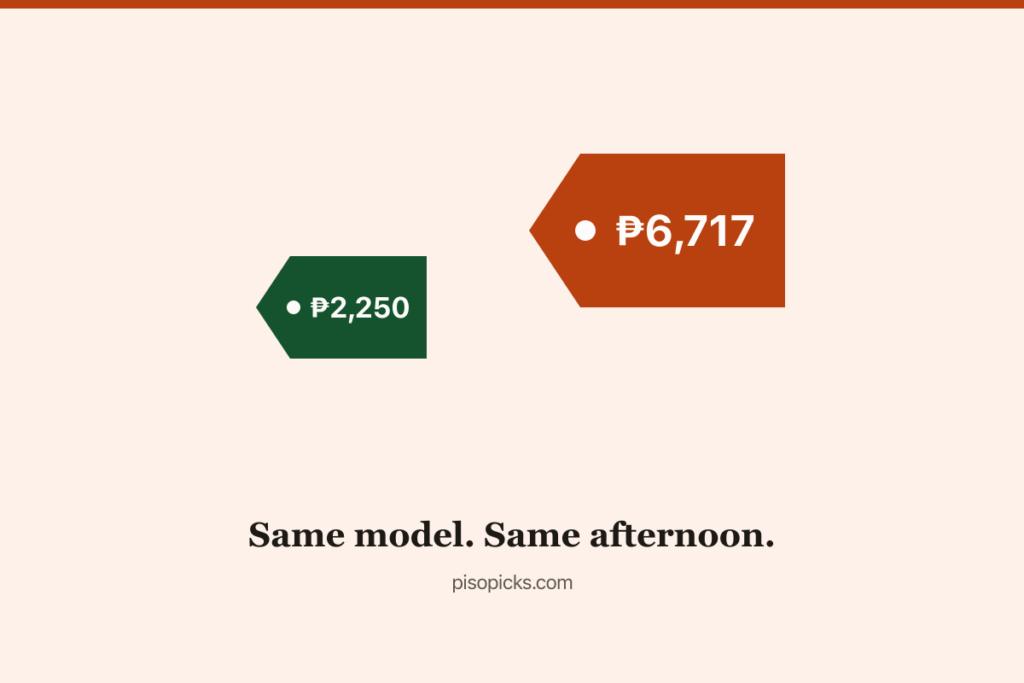
While researching our air fryer roundup, we priced one model — the Tough Mama NTMAF3, a 3-litre air fryer — on the same afternoon. Western Appliances had it at ₱2,250. Four different Lazada sellers had it at ₱2,599, ₱2,859, ₱3,822 and ₱6,717. The ₱6,717 listing was advertising a discount. This is not a glitch. It is how Philippine marketplaces work, and once you can see the pattern you cannot unsee it.
There are two kinds of seller, and the listing does not say which
The first kind is the brand’s own store, or an authorised retailer. Their price sits close to what the physical appliance shops charge, they hold stock, and the warranty is the manufacturer’s.
The second kind is a reseller account. Often it holds no stock at all: it lists the product, waits for an order, then buys it from the first kind of seller and has it shipped. Its margin is whatever it can add on top, and the way it competes is not on price but on search — titles stuffed with every keyword a buyer might type, dozens of near-identical listings, and a crossed-out “original price” that was never real.
When we matched our review picks to Shopee listings this month, every model showed the same shape: one or two official or authorised stores near the retail price, and then a long tail of reseller accounts at one and a half to four times that. A ₱3,229 air fryer from the brand’s store had reseller listings up to ₱11,752. A ₱2,399 rice cooker from the manufacturer’s store had copies at ₱3,692 to ₱8,039.
Six tells of a reseller listing
- The title is a keyword pile. “Air Fryer Airfryer 4L 5L Oil Free Healthy Cooking Kitchen Original Sale COD” is not a product name. A brand store writes “Asahi AF-300 3.0 L Air Fryer.”
- No model number anywhere. Resellers strip it so you cannot search for a cheaper copy of the exact item.
- The shop name is a string of letters or a generic phrase. “Tough Mama Appliances” or “Panasonic Philippines” is a brand store. “kitchenmall.ph_official” with 40 followers is not, whatever the word “official” is doing in there.
- A huge discount from a list price that no one ever charged. Marketplaces let sellers type any “original price.” A 61% discount to ₱1,939 means the ₱4,900 was fiction.
- The price is far above the physical retailer. For local brands, Western Appliances or SM Appliance Center is the honest baseline. If a marketplace listing is double that, you are looking at markup, not a premium product.
- Multiple listings of the same item from the same shop at different prices. This is a search-ranking tactic, not inventory.
How to find the real price in under a minute
- Get the model number from the brand’s website or a physical retailer’s listing.
- Search the marketplace for the model number, not the product type.
- Filter or sort by the Mall / Official Store badge, and check the shop name matches the brand.
- Compare that price to the physical retailer. The lower of the two is your real price; anything above it on the marketplace is somebody’s margin.
Why we link to the physical retailer even though it pays us nothing
Because for local brands it is routinely the cheapest option, and a review site that hides the cheapest option to protect a commission is not a review site. Every product in our reviews shows the physical-retailer price alongside the marketplace links, and we mark which ones earn us a commission. The disclosure spells out the arrangement.
Related reading
- Best air fryer in the Philippines under ₱3,000: our roundup, with the price each pick has to beat.
- Best small rice cooker for a condo: our roundup of three picks.
- Voltage and brownout checklist: five checks before a new appliance goes on the counter.
- How to check if makeup on Shopee is genuine: official store, the FDA lookup and the batch code.
Frequently asked questions
Why is the same product different prices on Lazada and Shopee?
Because most listings are from independent reseller accounts, not the brand. Each sets its own markup on top of the brand-store price, so the same model appears at many prices at once. The brand’s own store or a Mall-badged authorised retailer is usually the lowest.
Is the Mall or Official Store badge reliable?
It is the best single signal available. It means the marketplace has verified the seller as the brand or an authorised distributor. Check that the shop name also matches the brand — the word official inside a random shop name is not the same thing.
Are the big discounts on marketplace listings real?
Often not. Sellers can enter any original price, so a 60% discount may be measured against a figure no one ever charged. Compare the final price to the physical retailer instead of trusting the percentage.
Is it safer to buy from a physical store?
For local brands, the physical retailer is often cheaper and the warranty process is simpler. Marketplaces win on delivery convenience and vouchers. Either is fine if you buy from the brand store or an authorised seller; the risk is in reseller listings, not the marketplace itself.