

On this page · 7 sections
Almost. A turbo broiler and an air fryer are both convection ovens: a heating element and a fan moving hot air around the food, which is why both give you crisp food with little or no oil. The difference is the container. A turbo broiler is a tall glass bowl for big batches; an air fryer is a compact basket for small, fast ones. Here is where that difference matters, and which one to buy.
Which to buy, in one line: an air fryer (typically a 3–6 L basket) if you cook for one or two people on a small counter; a turbo broiler (typically a 10–12 L glass bowl) if you cook for five or more or roast whole chickens; and if you already own a turbo that works, keep it.
They are the same idea in a different box
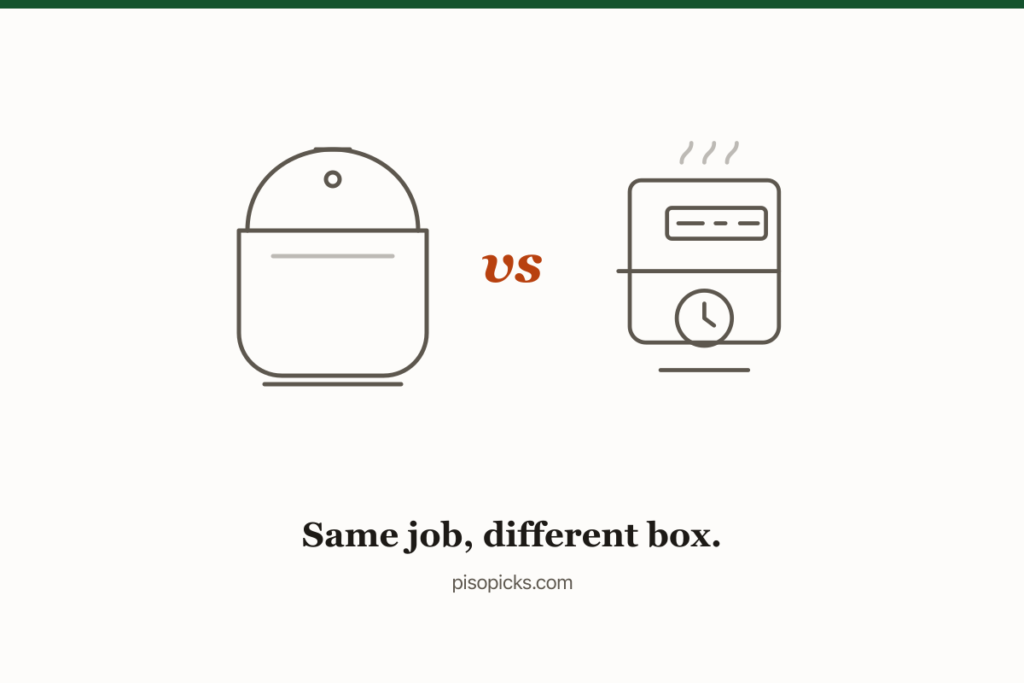
A turbo broiler is a glass bowl with a heating element and fan in the lid. An air fryer is a metal drawer with a heating element and fan on top. Both are convection ovens. The marketing on the air fryer is newer, and that is most of the difference in how people think about them.
What actually changes is the shape of the cooking space, and shape decides what each one is good at.
| Turbo broiler | Air fryer | |
|---|---|---|
| Cooking space | Round glass bowl, 10–12 L typical, tall | Flat basket, 3–6 L typical, shallow |
| Best at | Whole chicken, large roasts, big batches | Single-layer food: fries, wings, reheating |
| Preheat | Slower — the bowl has to come up to temperature | 3–5 minutes |
| Footprint | Large; the bowl does not nest | Compact; sits on a narrow counter |
| What wears out | Halogen bulb, bowl can crack if shocked | Non-stick basket coating |
| Cleaning | Glass — easy, but heavy and awkward in a small sink | Basket soaks; must avoid abrasives |
| Typical power | 1,200–1,400 W | 800–1,600 W |
Where the turbo wins
Volume. A whole chicken, a kilo of liempo, a tray of lumpia for a gathering — the turbo’s tall bowl takes food the air fryer basket simply cannot hold in a single layer. If your household regularly cooks for five or more, or you roast rather than fry, the turbo is the better tool and the air fryer will frustrate you.
Durability, arguably. There is no coating to fail. Glass and a bulb are the wear items, and both cost far less to replace than a whole new appliance.
Where the air fryer wins
Speed and space. It preheats in the time a turbo takes to warm its bowl, and it fits a condo counter that has no room for a 12-litre glass dome. For one or two people cooking a few hundred grams at a time, that speed is the whole appeal: a batch of fries from the freezer to the plate in under fifteen minutes with no oil to deal with afterward.
Crispness on small batches, too. The flat basket keeps everything in the moving air. A small batch at the bottom of a deep turbo bowl sits further from the element and browns less evenly.
Which one costs less to run?
About the same per hour. Turbo broilers are usually rated 1,200 to 1,400 W and air fryers 800 to 1,600 W. At the ₱15.06 per kWh Meralco rate we use in our air fryer electricity guide, a 1,200 to 1,400 W unit costs roughly ₱18 to ₱21 for an hour at full power. That is a ceiling, because the heater cycles on and off once the appliance is hot.
What changes the bill is minutes, not the box. A small batch of fries in an air fryer that preheats in 3 to 5 minutes usually runs for less time than the same batch in a turbo bowl that has to warm up first. A whole chicken is the reverse: one turbo cycle does the job, where an air fryer would need several batches. Put your own wattage and hours into our electricity cost calculator to see what it adds to your bill, or read how much electricity a turbo broiler uses for the cost per cook and per month.
The verdict, by household
- You already own a turbo that works: keep it. Buying an air fryer as well is redundant, not additive. Spend the money on a better rice cooker.
- Condo, one or two people, no exhaust hood: air fryer. Its compact footprint and contained smell matter more than anything else on this list. Our picks under ₱3,000 are sized for exactly this.
- Family of five or more, you roast whole chickens: turbo broiler. The air fryer will feel small within a month. Our turbo broiler picks compare the models on sale, with prices.
- You own neither and cook fried food most days: air fryer for one or two people, turbo for a family. If you are in between, the air fryer’s faster cycle makes it the one you will actually reach for on a weeknight.
Leaning towards an air fryer? We checked four models against their manufacturers’ own spec sheets and priced the top pick across sellers on one afternoon. See our air fryer picks under ₱3,000, and read why the same model can cost ₱2,250 in one place and ₱6,717 in another before you buy.
Related reading
- Best turbo broiler in the Philippines: eight models checked, with prices and warranties.
- Is an air fryer worth it?: when it earns its counter space and when it does not.
- What the litres on an air fryer really mean: how to size one and read a listing.
- How much electricity an air fryer uses: cost per cook and per month at Meralco’s rate.
- Best air fryer in the Philippines under ₱3,000: our roundup, with the price each pick has to beat.
Frequently asked questions
Is a turbo broiler the same as an air fryer?
Not exactly, but they work the same way. Both are convection ovens: a heating element and a fan moving hot air around the food. The difference is the container. A turbo broiler is a tall glass bowl, typically 10–12 L, suited to whole chickens and big batches. An air fryer is a shallow basket, typically 3–6 L, suited to small single-layer batches.
What is the difference between an air fryer and a turbo broiler?
Size and shape. A turbo broiler has a tall 10–12 L glass bowl and takes longer to come up to temperature. An air fryer has a compact 3–6 L basket that preheats in 3–5 minutes. The turbo suits roasts and bigger households; the air fryer suits one or two people and small counters.
Is an air fryer just a small turbo broiler?
Functionally, yes. Both are convection ovens — a heating element and a fan moving hot air around the food. The air fryer’s flat basket suits small single-layer batches; the turbo’s tall bowl suits whole chickens and large quantities.
Which uses more electricity, a turbo broiler or an air fryer?
Similar wattage — turbo broilers are usually 1,200 to 1,400 W and air fryers 800 to 1,600 W — but the air fryer typically runs for less time per batch because it preheats faster, so a small batch costs slightly less to cook. For large batches the turbo wins because it cooks more per cycle.
Can a turbo broiler make food as crispy as an air fryer?
For a full bowl, yes. For a small batch, an air fryer usually browns more evenly because the food sits close to the element in a shallow basket, while a small portion in a deep turbo bowl is further from the heat.
Should I replace my turbo broiler with an air fryer?
Not if it still works and it suits how much you cook. The two do overlapping jobs. Replace it only if the bowl has cracked, or if you have downsized to a kitchen where the turbo no longer fits.
Which is better, a turbo broiler or an air fryer?
Neither is better for everyone. An air fryer is better for one or two people, small counters and quick small batches. A turbo broiler is better for families of five or more and for roasting whole chickens or large batches. If you already own a turbo that works, you rarely need an air fryer as well.